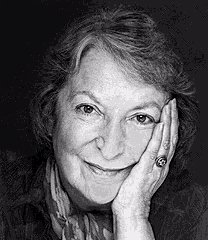
 Pauline Kael
Occupation: Critic, author
Born: June 19, 1919, Sonoma County, CA
Education: University of California, Berkeley (philosophy)
Prolific, enduring columnist for The New Yorker magazine, Pauline Kael remains the most influential
American film critic of the last 50 years.
Kael settled in Berkeley after graduating, made some short films, and wound up managing movie theaters and broadcasting for the Pacifica radio station. She reached national attention in the 60s, first in a brief stint as critic for The New Republic, finally as a longtime fixture at The New Yorker (1968-1991). Along with Andrew Sarris and John Simon, she helped to shape the new film culture of the 60s and 70s. While Sarris championed the French auteur theory and Simon eloquently represented the conservative, literate tradition, Kael reminds us constantly of the personal, emotional, visceral excitement of movies. This is a quintessentially American approach to the art that continues the tradition established by Vachel Lindsay in the 20s. For Kael, movies are near-sexual experiences, as the titles of her critical anthologies suggest: I Lost It at the Movies, Kiss Kiss Bang Bang, Going Steady, Deeper Into Movies, Reeling, When the Lights Go Down, Taking It All In, Movie Love. Her general guidebook, 5001 Nights at the Movies, was revised in 1991.
Kael's career has been almost as passionate and dramatic as her approach to movies. She was notorious in the 60s for her controversial opinions, especially in defense of gutsy American movies (like Bonnie and Clyde) versus intellectual European films (like Blowup). In 1971, her essay Raising Kane, critical of the received opinion of Orson Welles, created an historical controversy in the film community. In 1972, her rave review of Last Tango in Paris caused a public stir. In 1974, her angry - and much-discussed - essay On the Future of Movies sketched a cynical picture of the American film industry as a battleground between venal businessmen and pusillanimous (albeit talented) directors. A year later, she offended fellow critics by scooping them, reviewing Robert Altman's Nashville from a rough cut several months before it was released. (She hailed it as "an orgy for movie-lovers.") In a final affront to accepted critical mores, she jumped ship in 1979 to take a job at Paramount in Hollywood as "Executive Consultant." It was a measure of both her remarkable power and her engaging sense of life as a work of art. Five months later, she quit to return to the pages of The New Yorker, where she lived out the 80s - like the movies she had to write about - quietly, commercially, and without much controversy, as the focus of film criticism shifted from the sensuality of the printed page to the thumbs-up consumerism of TV. When she retired from The New Yorker in February, 1991, she told The Hollywood Reporter: "I was lucky enough to work in that great period of filmmaking between the 60s and the early 70s when filmmakers took chances," although she concluded that, when she began writing reviews, "films were as dull as they are now." In between, Pauline Kael contributed much to the excitement. - Baseline
The originality of Pauline Kael's mind and temperament, her formidable intelligence, her eloquent use of the vernacular, her extraordinary analytical powers, her insight into character, her ability to shed light wherever the real world intersects with the world on film, her enormous gift for social observation, the wit and energy and clarity of her prose all go into making her the singular critic she is. What she is primarily is a writer; one reads her for the sheer pleasure her writing affords. Her opinions are forceful, convincing, often unexpected, but whether or not one agrees with them one comes away from her writings in a state of exhilaration. - William Shawn
Information courtesy of Cinemania
© 1996 Microsoft Corporation and/or its suppliers. All rights reserved.